
Downspout Drain Installation in Mahoning County, Ohio
Roof-water drainage needs vary substantially from property to property throughout Mahoning County. AB Drain and Construction LLC evaluates the complete route — from the roof downspout to the final discharge location — rather than simply burying a short extension. New installation, failed-line evaluation, rerouting, and buried gutter drain replacement across the county. No bull.
"Dry Basement/Yard ~ NO BULL"
Documentation available upon request
Why Downspout Water Matters
Gutters and downspouts concentrate water from a large roof area into a few specific discharge points. When that water repeatedly discharges near the house or into a poorly drained area, it can contribute to the problems below. Downspouts are not the cause of every basement water problem — but they are a common and often overlooked contributor.
- Saturated soil near the foundation
- Wet basement conditions
- Standing water in the yard
- Muddy or unusable lawn areas
- Water movement toward the home
- Repeated erosion or washout
- Recurring wet areas near structures
Signs of a Downspout Drainage Problem
If any of these sound familiar, your downspouts may be part of a drainage problem worth fixing before the next storm.
Downspout ends beside the foundation
The downspout discharges right next to the basement walls instead of being carried away.
Short extensions move or disconnect
Plastic extensions stretched across the lawn come off, get kicked, or end up in the same wet spot.
Water pools where the downspout discharges
The same area floods every rain because the water has nowhere to go.
Existing underground drain backs up
Water returns from a buried line instead of flowing out — a sign of a clog or break.
Yard stays wet along an old drain route
A buried line that no longer works leaves a strip of soggy lawn above it.
Buried drainage pipe is damaged or collapsed
Old underground lines can crack, crush, or separate over time.
Downspout disconnected from an old line
The downspout was knocked off or never properly tied into the buried system.
Water collects near a garage, patio, or driveway
Roof runoff pools around outbuildings and hardscape on the property.
Solid Downspout Pipe vs. French Drain
Concentrated roof runoff and subsurface yard water are different problems — and they usually need different drainage solutions.
Solid Downspout Pipe
Carries concentrated roof runoff underground and moves it away from the structure to a discharge point — without intentionally releasing water along the route.
Perforated French Drain
Intercepts accumulating or subsurface water and carries it to a discharge point. It serves a different purpose than a solid downspout line.
Roof runoff and yard drainage are not the same problem.
Dumping concentrated roof runoff into an improperly designed perforated French drain can overwhelm a system meant for subsurface flow. That is why AB Drain evaluates both roof runoff and yard drainage rather than automatically treating them as the same water problem.
Existing Underground Downspout Drain Problems
Older underground drainage lines can develop problems over time. We do not assume we can diagnose every buried drain problem without inspecting it — and where appropriate, camera inspection methods may be used to locate the issue when inspection is possible and right for your downspout drain.
- Damage or cracks in the buried line
- Separation or disconnected sections
- Collapse of an old pipe
- Root intrusion where applicable
- Sediment or debris accumulation
- Poor routing to a bad discharge point
- Unknown or buried discharge location
- Downspout disconnected from the line
AB Drain's Downspout Drainage Approach
Inspect the Downspouts & Problem Areas
We look at where the downspouts discharge and where the water is collecting.
Identify Where Roof Water Discharges
We figure out which downspouts are feeding the problem area and how much water each contributes.
Evaluate Existing Buried Drainage
Where an underground line already exists, we check whether it still works or needs replacing.
Evaluate How Water Moves
We trace how runoff travels across the property before it collects.
Identify Discharge Options
We find a practical, lawful place for the collected roof water to go.
Recommend the Right Drainage Plan
Based on the findings, we recommend the system that fits your property — not a one-size-fits-all pipe.
Install or Replace the System
Our experienced crew installs or replaces the underground drainage and restores the surface.
Review the Completed Work
We walk you through the finished drainage work so you understand how it functions.
Recent AB Drain Projects
Examples of our underground downspout and exterior drainage work.
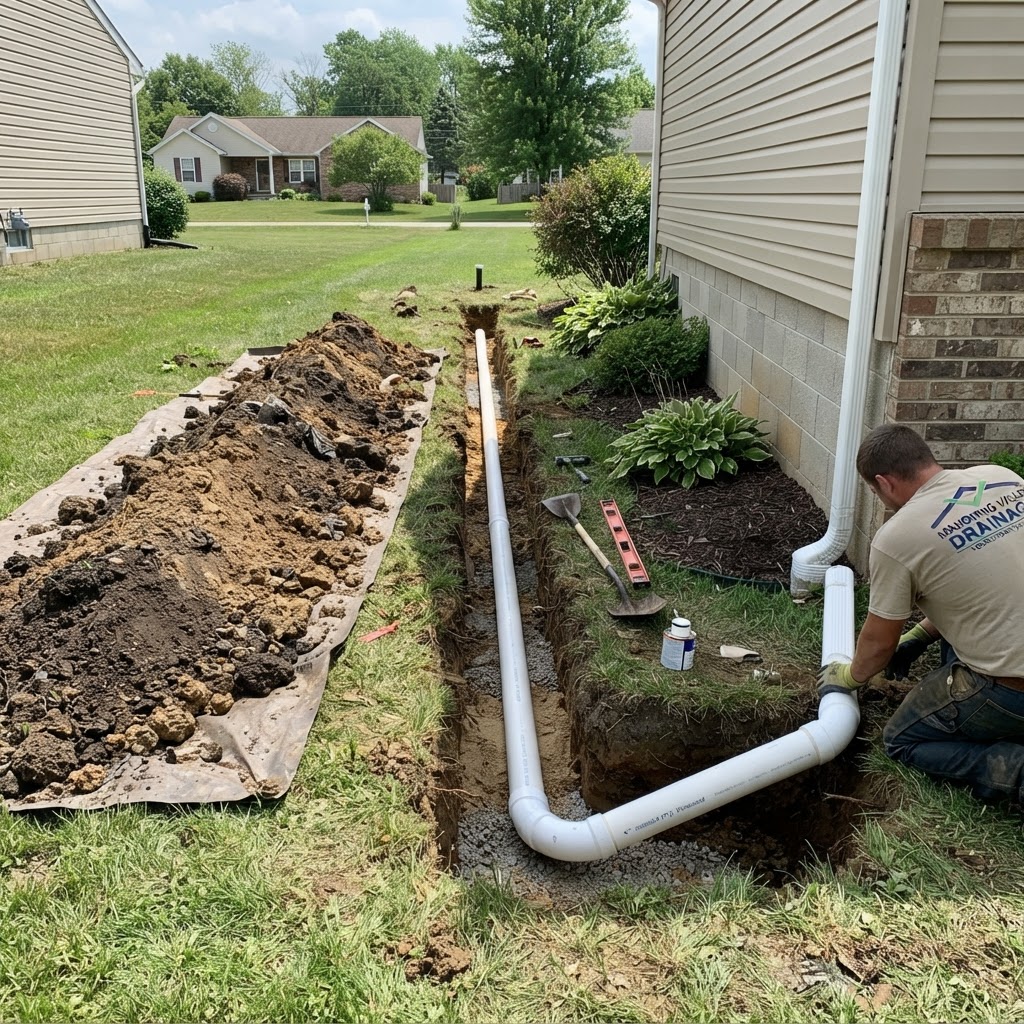
Underground Downspout Drain — Excavation
Youngstown, OH
Solid PVC pipe trenched from a gutter downspout and routed away from a home's foundation, moving concentrated roof runoff underground instead of letting it saturate the soil beside the walls.
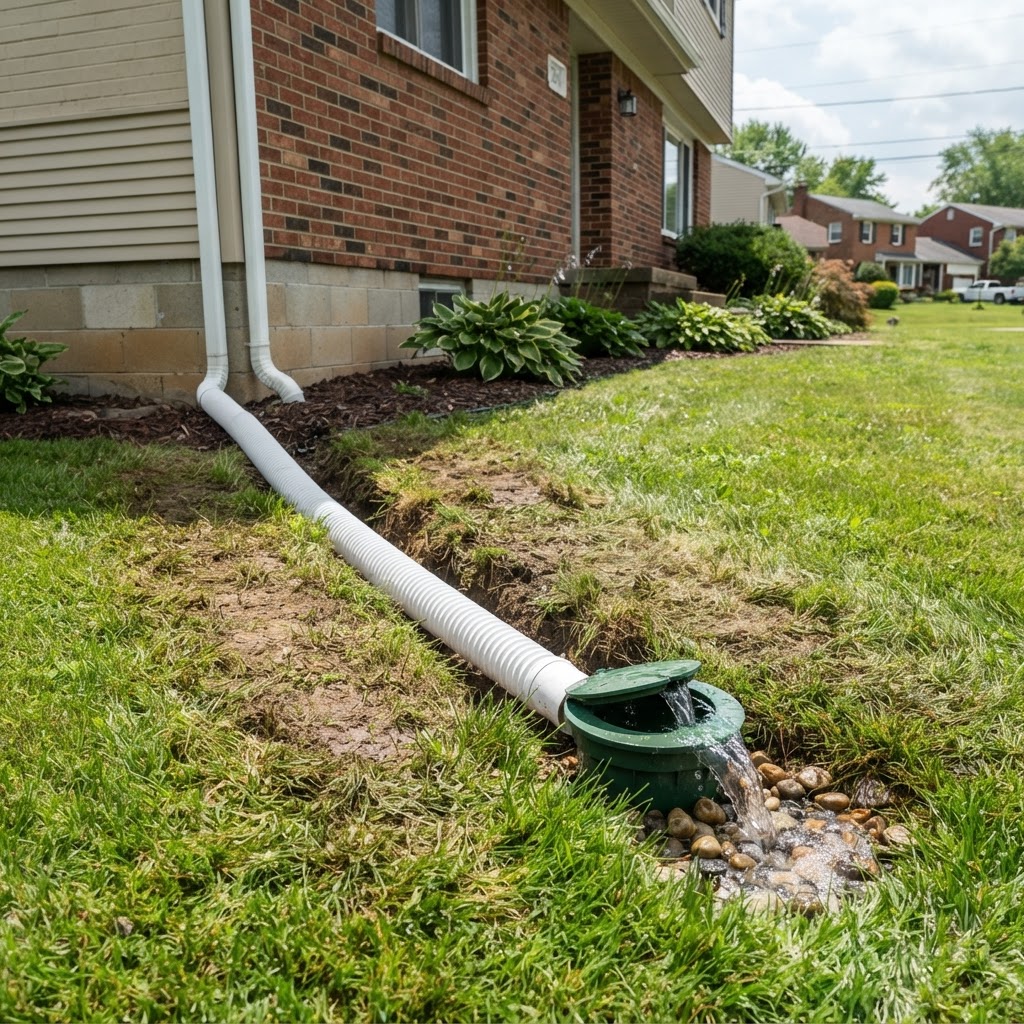
Buried Downspout Extension — Pop-Up Emitter
Youngstown, OH
The underground downspout line daylights at a pop-up emitter in the lawn, releasing roof runoff well away from the foundation and closing when dry to keep out debris.
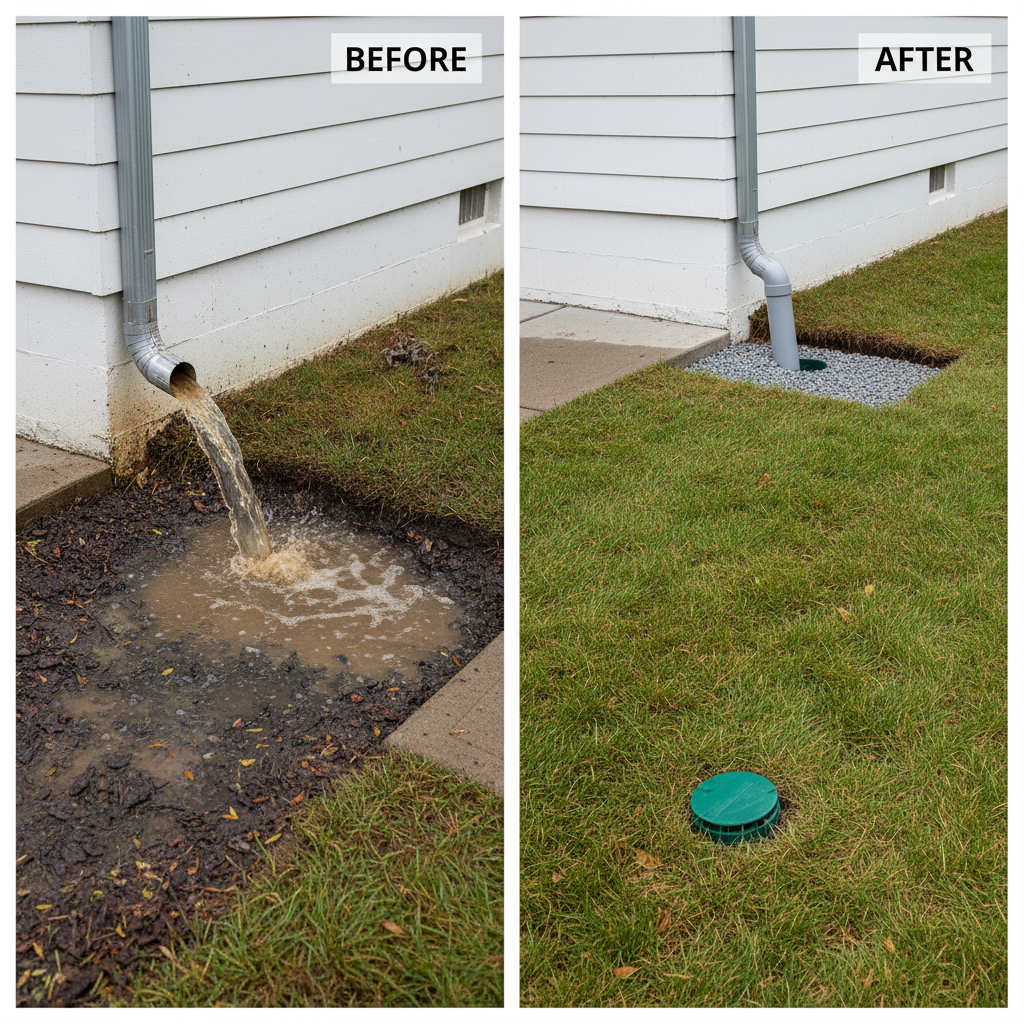
Underground Downspout Drain — Before & After
Boardman, OH
Left: downspout discharging directly against the foundation, saturating the soil with every rain event. Right: underground pipe connected to the gutter outlet and routed away, discharging at a pop-up emitter in the yard.
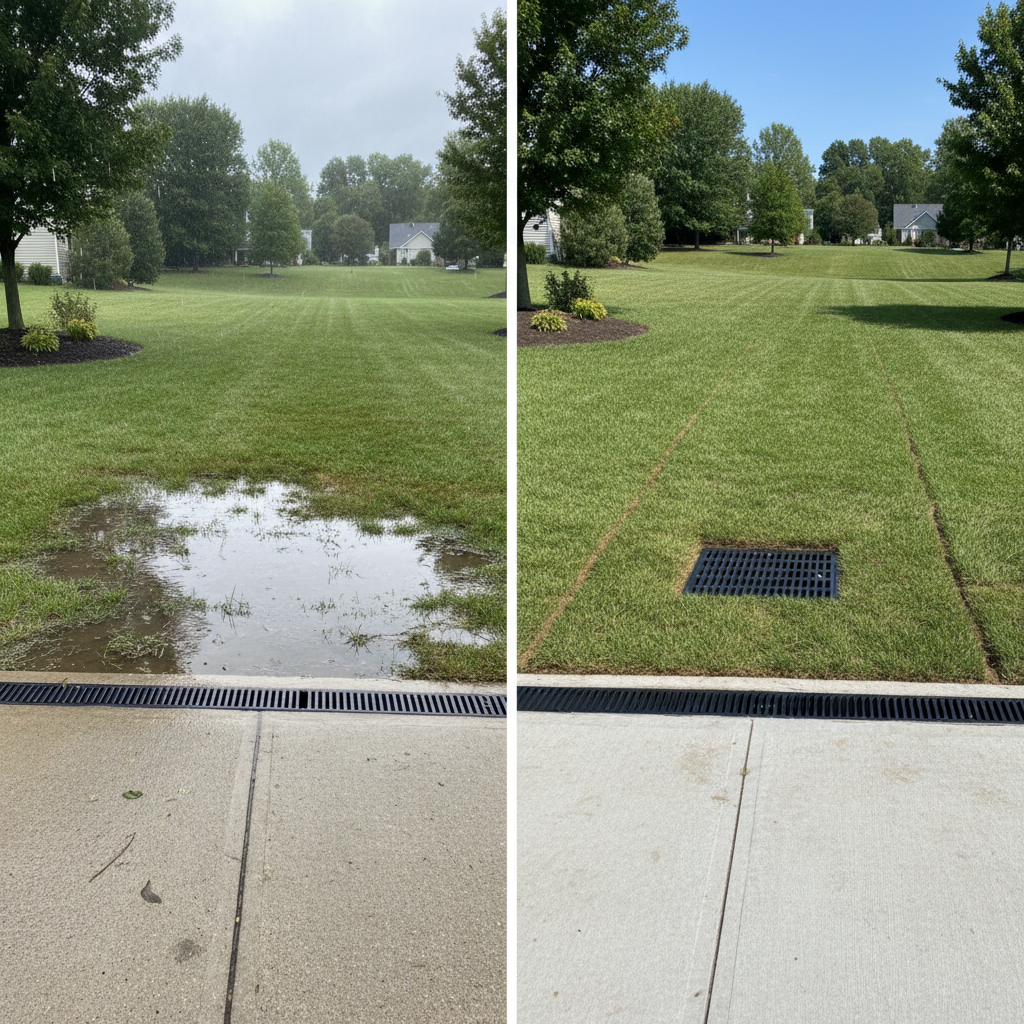
Catch Basin & Channel Drain — Before & After
Canfield, OH
Left: low point in driveway collecting standing water with no outlet. Right: catch basin with grate installed at the low point, connected to underground piping that routes water to a safe discharge location away from the property.
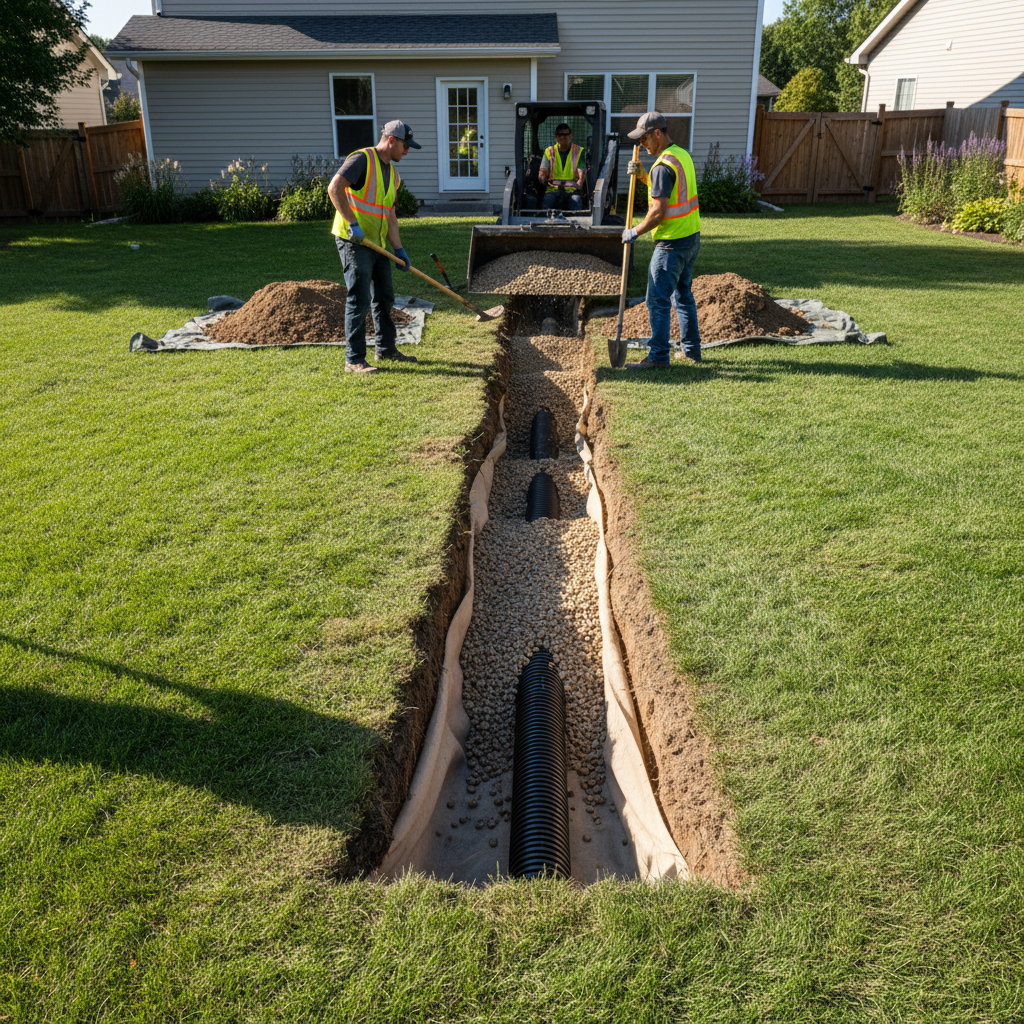
French Drain & Yard Drainage — Completed
AB Drain Project
Completed integrated drainage system with French drain, catch basin, and underground downspout connections all tied into a single discharge line. Surface restored to its original grade with proper slope away from the foundation.
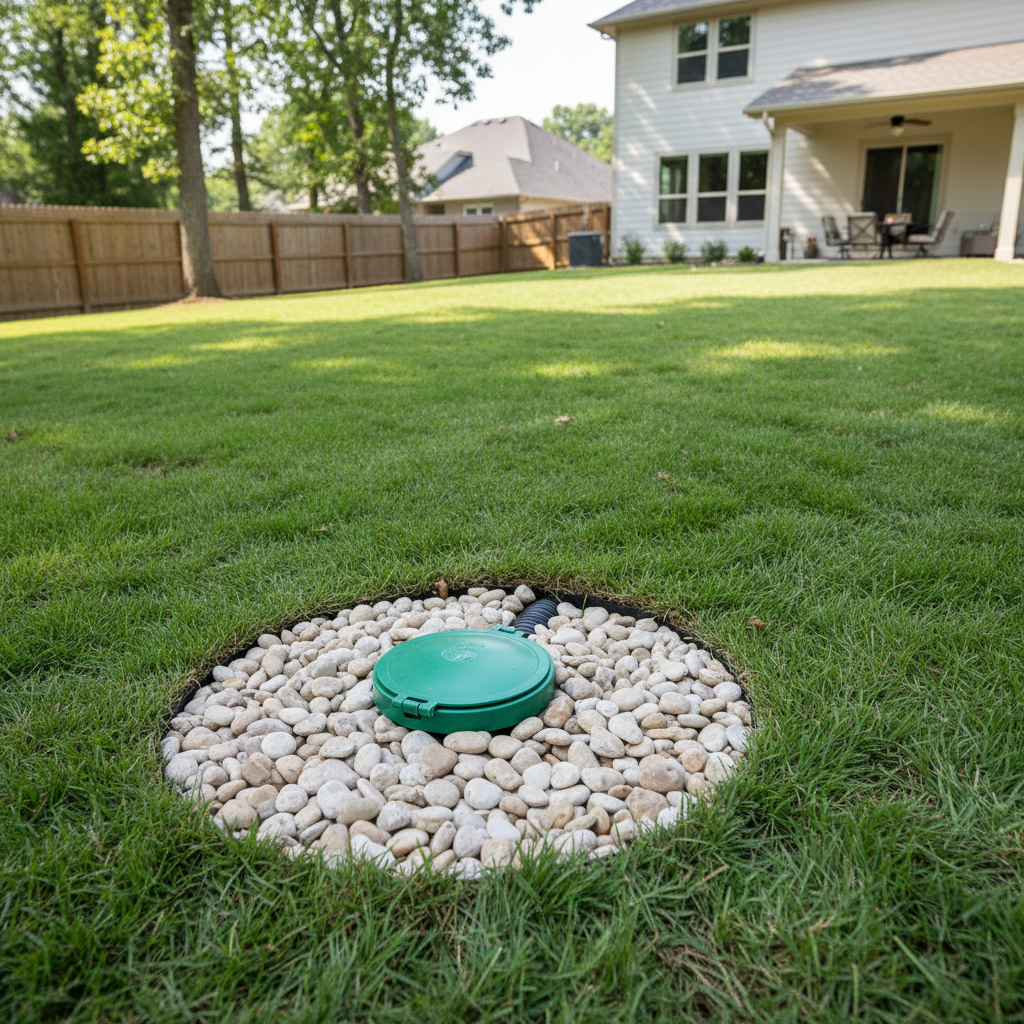
Yard Drainage — Pop-Up Emitter & Finished Lawn
AB Drain Project
A pop-up emitter at the end of the underground drain line opens automatically under water pressure to release collected water far from the foundation, then closes when dry to prevent debris and pests from entering the pipe.
Why Choose AB Drain for Downspout Drainage
Drainage-Focused Experience
Roof runoff, underground drainage, and yard drainage work is a core part of what we do — not an add-on.
Owner Involved & On Site
The owner is involved and on site — you deal directly with the people responsible for the work.
Direct Communication
We explain what we found, what we recommend, and why — in plain language, not jargon.
Roof Runoff vs. Subsurface Water
We know concentrated roof water and subsurface yard water are different problems that usually need different solutions.
Customized Drainage Planning
Every property is different. We plan the drainage path and discharge location around your specific lot.
NO BULL Approach
We figure out where the water is really going before we recommend a system. No upselling, no bull.
What AB Drain Customers Say
Reviews from homeowners across our service area in Ohio and Pennsylvania.
After years of dealing with a wet basement, AB Drain installed a complete drainage system. It's been bone dry ever since — even during the heaviest storms. Worth every penny.
Professional from start to finish. The crew was punctual, respectful of our home, and finished ahead of schedule. Our crawl space has never been drier.
We were nervous about the cost, but their financing made it totally manageable. The team explained everything clearly and delivered exactly what they promised.
Downspout Drainage in Mahoning County, Ohio
AB Drain and Construction LLC serves homeowners throughout Mahoning County and the surrounding Mahoning Valley — including Youngstown, Boardman, Canfield, Poland, Austintown, Struthers, Campbell, Lowellville, New Middletown, Sebring, Beloit, and North Lima. These are service areas, not physical office locations. We come to your property, evaluate the roof runoff and drainage problem firsthand, and design a downspout drainage solution built around your specific lot.
Roof-water drainage needs can vary substantially from property to property throughout Mahoning County. Conditions that may be encountered include downspouts terminating beside foundations, short above-ground extensions, water entering low or saturated areas, multiple downspouts serving one property, long underground runs, confined side yards, water collecting between structures, larger residential lots, elevation changes, existing buried lines with unknown outlets, older drainage systems, clogged lines, separated joints, crushed or collapsed piping, improper pitch or routing, undersized or ineffective systems, roof runoff contributing to wet yards, roof runoff contributing to foundation saturation, and difficult or limited discharge routes. These are conditions that may be present — not conditions we assume every property has. Our job is to find which ones apply to your home.
AB Drain takes a diagnosis-first approach. Before installing or replacing underground downspout drainage, we evaluate the number and location of downspouts, roof-water concentration points, existing buried lines, whether existing outlets can be identified, property elevations, available fall, obstacles, yard drainage, foundation proximity, surface-water conditions, subsurface-water conditions, available discharge locations, whether several downspouts should remain separate or may be combined where appropriate, and whether other drainage systems are also needed. The correct route depends on where the roof water can actually go after it enters the underground line — not on a generic layout applied to every property.
An underground downspout drain performs four basic functions: it RECEIVES concentrated roof runoff from the downspout, TRANSPORTS it through solid, non-perforated drainage piping, MOVES it away from the foundation and other vulnerable areas, and DISCHARGES it at an appropriate functional location. The complete route matters. A buried pipe that ends in a chronically wet location or has no useful outlet has not solved the roof-water problem — it has only moved the water to a different part of the yard.
The distinction between a solid downspout drain and a perforated French drain is central to roof-water management. An underground downspout drain uses solid, non-perforated pipe primarily to TRANSPORT concentrated roof runoff. A French drain uses perforated pipe surrounded by drainage stone primarily to INTERCEPT surrounding groundwater and subsurface water. These systems perform different hydraulic jobs — one carries roof water, the other collects groundwater. A property may require both, but concentrated roof runoff should not automatically be discharged into perforated French-drain piping, because it can overwhelm a system built for subsurface flow.
Many Mahoning County homes have existing buried gutter drains that no longer work the way they were installed to. Warning signs include water backing up at the downspout, overflow beside the house, slow drainage, water surfacing unexpectedly, wet ground along the buried route, repeated saturation over the line, a missing or unknown outlet, separated fittings, crushed or collapsed pipe, root, sediment, or debris restriction, and drainage that used to work but no longer does. Depending on condition, the appropriate solution may involve clearing, repair, rerouting, partial replacement, or full replacement. We do not promise that every system can be cleared or repaired, and we do not promise that every buried line can always be fully located.
There is a real difference between designing a new underground downspout system and correcting an existing failed one. For a new installation, we plan the route, the pipe function, the elevation, the downspout locations, the discharge strategy, and the yard conditions as a single design. For an existing system, we determine what is already underground, identify why it failed, evaluate whether the original route is still appropriate, and decide whether repair, rerouting, or replacement makes sense. Replacing a failed line along the exact same route is not always the best solution if the original design was poor — sometimes the route itself is the problem.
Downspout system design depends on the number of downspouts, the roof areas served, pipe sizing based on system design, the length of the underground run, available fall, changes in direction, line connections, yard conditions, obstacles, and the discharge point. We do not give one universal pipe diameter, pitch, maximum run length, or distance from the house — those depend on property conditions and system design. A system that works on one lot may be wrong for the next, which is why the design is built around your property rather than a fixed specification.
Every underground downspout system needs a functional destination. Discharge strategy depends on property elevation, lot layout, existing drainage infrastructure, available drainage routes, surface-water conditions, and applicable local requirements. We do not make universal statements that curb or street discharge is permitted, and we do not invent municipal requirements. The discharge point has to work with the property as it exists — a long line that discharges into another wet area has only moved the problem.
Roof runoff is only one possible source of exterior water. A complete drainage picture distinguishes and relates solid underground downspout drainage for roof water, French drains for subsurface water, catch basins or grates for surface-water collection, sump discharge drainage, grading or surface-water corrections, and existing drainage repair or replacement. Some Mahoning County properties require multiple systems working together — and AB Drain evaluates where the water from each system ends up, not just how to get it into the ground.
When downspouts discharge too close to the foundation or an underground line has failed, concentrated roof runoff may remain near the house and contribute to surrounding soil saturation. That saturation can in turn contribute to basement-water problems. Roof-water management may be one component of a broader basement waterproofing or exterior drainage strategy — but downspout drains alone will not solve every wet basement. If water is already entering through the walls or floor, that is a basement waterproofing issue, and we look at the complete drainage picture.
Because roof-water drainage challenges differ across Mahoning County, we maintain dedicated underground downspout drain pages for the communities we serve most. In Youngstown, the focus is older and failed buried drainage and foundation-adjacent roof runoff. In Boardman, it is constrained residential layouts and side-yard routing. In Canfield, it is larger lots, multiple downspouts, and longer runs. In Poland, it is legacy drainage and changed property layouts. For the full range of solutions, see our Underground Downspout Drains master service page. No bull.
We are fully insured and bonded, and licensed where required, and because we install underground downspout drains, French drains, catch basins and grates, sump discharge drainage, exterior yard drainage, and basement waterproofing where appropriate, we can evaluate the complete water problem rather than simply burying pipe. For related drainage solutions across the county, see our Mahoning County French drain and Mahoning County basement waterproofing pages, or our Underground Downspout Drains master service page.
When roof runoff collects near your foundation, it is often a basement water problem as well. See our Basement waterproofing solutions throughout Mahoning County for how we handle water that has reached the foundation.
We also install and replace underground downspout drains for homeowners in nearby Youngstown, Boardman, Canfield, and Poland.
What Affects the Scope and Price of Downspout Drainage
Every property is different. These are the factors that shape the scope and cost of underground downspout drainage — and why a free inspection matters before any recommendation.
Number of downspouts
Each downspout that needs underground drainage is a separate run. More downspouts mean more excavation, pipe, and discharge components.
Drainage distance
The farther the water needs to travel from the downspout to a safe discharge point, the more excavation and pipe are required.
Existing drain condition
If you have an old underground drain that is clogged, collapsed, or disconnected, we evaluate whether it can be cleared or needs replacing. This affects the scope.
Discharge location
The water needs a safe, lawful place to go — a pop-up emitter, dry well, or low area away from the foundation. The available discharge options on your lot affect the design.
Excavation and access
Landscaping, hardscape, slopes, and underground utilities all affect how the work is performed. We discuss access considerations during the estimate.
What to Expect During Your Free Downspout Drainage Estimate
No pressure, no obligation, no bull. Here is exactly what happens when you call AB Drain for a downspout drainage estimate.
We inspect the downspouts
We look at where each downspout discharges and where the water is collecting.
We evaluate existing buried drainage
Where an underground line already exists, we check whether it still works or needs replacing.
We identify discharge options
We find a practical, lawful place for the collected roof water to go on your specific lot.
We recommend the right plan
Based on what we find, we recommend the system that fits your property — not a one-size-fits-all pipe. You get a written estimate with no obligation.
After Installation: Keeping Your Downspout Drains Working
An underground downspout system is a long-term investment. These simple maintenance steps keep it working — and keep roof runoff away from your foundation.
Inspect discharge points
Check your pop-up emitter or discharge outlet periodically to make sure water is flowing freely and the area around it is not eroding.
Keep emitters clear
Pop-up emitters can stick closed from debris or frost. A quick check during heavy rain confirms the system is discharging properly.
Check downspout connections
Make sure the downspout remains securely connected to the underground pipe. A disconnected downspout dumps water right back at the foundation.
Watch for backups
If water backs up from an underground drain during heavy rain, the line may be clogged or damaged. Call us — we can inspect the line and diagnose the problem.
Based in Youngstown — Serving Mahoning County & the Surrounding Region
AB Drain and Construction LLC is based in Youngstown, Ohio. We travel to serve homeowners across the Mahoning Valley and the broader corridor from Cleveland to Pittsburgh — including Mahoning County. When you call, you work directly with the owner and the crew doing the work, not an out-of-town call center.
Downspout Drainage FAQs
What is the purpose of an underground downspout drain?
An underground downspout drain gives concentrated roof runoff a controlled path away from the house. It receives the water from the downspout, transports it through solid piping, moves it away from the foundation and other vulnerable areas, and discharges it at an appropriate functional location. The purpose is not to hide a pipe — it is to move roof water somewhere it can go without creating a new problem.
Should buried downspout drains use solid or perforated pipe?
Solid, non-perforated pipe. A buried downspout drain is meant to TRANSPORT concentrated roof runoff to a discharge point without releasing it along the way. Perforated pipe is meant to ACCEPT subsurface water from the surrounding soil — that is a French drain, not a downspout drain. Using perforated pipe for roof runoff can let water out along the route and saturate the surrounding soil, which defeats the purpose of moving the water away.
What is the difference between an underground downspout drain and a French drain?
An underground downspout drain uses solid pipe to transport concentrated roof runoff from the gutters to a discharge point. A French drain uses perforated pipe surrounded by drainage stone to intercept and accept groundwater and subsurface yard water. These systems perform different hydraulic jobs — one carries roof water, the other collects groundwater. A property may require both, but concentrated roof runoff should not automatically be discharged into perforated French-drain piping.
How do I know if my buried gutter drain is clogged or collapsed?
Signs include water backing up at the downspout, overflow beside the house, slow drainage, water surfacing unexpectedly in the yard, wet ground along the buried route, repeated saturation over the line, a missing or unknown outlet, separated fittings, crushed or collapsed pipe, root, sediment, or debris restriction, and drainage that used to work but no longer does. Any of these can indicate a clog, collapse, separation, or root intrusion. We evaluate the line to determine what is happening before recommending a fix.
Why is water backing up at my downspout?
Common reasons are a clog, sediment or debris buildup, root intrusion, a collapsed or separated pipe, a poor pitch that no longer carries water, or a discharge point that is blocked, buried, or no longer works. A single restriction anywhere along the line can cause the whole system to back up — and the water often shows up right back at the foundation. We inspect the line to find out where and why it is backing up before recommending a fix.
What if I do not know where my buried downspout drain goes?
We evaluate where a buried line appears to run by tracing the route from the downspout, looking for where water surfaces or backs up, and attempting to identify the outlet. Not every buried line can be fully located — site conditions, depth, landscaping, and whether the line is still intact all determine what can reasonably be verified. We tell you honestly what we were able to confirm and what we could not, and we recommend the right path forward based on what is found.
Can multiple downspouts connect to one underground drainage system?
Often, yes. When several downspouts serve different portions of a house, individual lines can sometimes be routed to a shared discharge point where the layout and pipe sizing allow it. Whether combining lines makes sense depends on the volume each downspout carries, the available fall, the route, and the discharge location. We design the system around your roof and your property rather than assuming every downspout should tie into one pipe.
How far can an underground downspout drain run?
There is no single universal maximum run length. How far a line can run depends on the available elevation and fall across the property, the pipe sizing, the water volume, the route, the obstacles, and the discharge strategy. A longer run is workable when the route and the discharge point are planned together; a long line that ends in a chronically wet area or has no useful outlet has not solved the problem. We plan the complete route before any pipe goes in the ground.
Where should an underground downspout drain discharge?
To a point chosen for your property — a pop-up emitter in the yard, a dry well, a safe low area, or another suitable drainage strategy. Discharge strategy depends on property elevation, lot layout, existing drainage infrastructure, available drainage routes, surface-water conditions, and applicable local requirements. We do not make universal statements that curb or street discharge is permitted, and we do not invent municipal requirements. The discharge point has to actually work, or the length of the line does not help.
Can underground downspout drainage help with basement water?
It can be one part of the solution. Concentrated roof runoff discharged beside a foundation can contribute to soil saturation around the house, and correcting downspout drainage can reduce that contribution. But underground downspout drains alone will not fix every wet basement — if water is already entering through the walls or floor, that is a basement waterproofing issue. Roof-water management may be one component of a broader basement waterproofing or exterior drainage strategy.
Can roof runoff cause a wet yard?
Yes. Downspouts concentrate water from a large roof area into a few discharge points, and when those points empty into a low area, a saturated side yard, or an already-wet part of the lot, the yard stays wet long after the rain stops. A buried downspout line that discharges into another chronically wet area has only moved the problem. We evaluate where the water ends up after it leaves the pipe, not just how to get it into the ground.
Can a failed buried gutter drain be repaired instead of replaced?
Sometimes, yes — depending on what is found. If the problem is a localized clog, a single separated joint, or a restricted section, clearing or a targeted repair may be enough. If the line is collapsed, crushed, poorly routed, or deteriorated throughout, rerouting or full replacement is often the more reliable solution. We do not promise that every system can be cleared or repaired; we tell you what the line needs and why.
Can downspout drains, French drains, and catch basins be used together?
Yes, and on many Mahoning County properties that is exactly what is needed. A solid downspout drain handles roof runoff, a perforated French drain handles subsurface water, a catch basin handles surface water at a low point, and sump discharge drainage handles pump output. Each is designed for a different water source. We evaluate how the systems interact and where the water ends up after it leaves each pipe.
Can AB Drain determine whether my existing system should be cleared, repaired, rerouted, or replaced?
Yes. We inspect the existing line, evaluate whether it is clogged, separated, crushed, collapsed, poorly pitched, undersized, or poorly routed, and determine whether clearing, repair, rerouting, partial replacement, or full replacement is appropriate based on what is found. Not every buried line can be fully located or repaired; we tell you honestly what the line needs and why.
How much does underground downspout drainage cost in Mahoning County?
Cost depends on the number of downspouts, drainage distance, excavation access, existing drainage conditions, obstacles, discharge options, materials, system design, and whether an old line is being cleared, repaired, rerouted, or fully replaced. We do not quote a fixed price without seeing the property. We start with a free inspection and give you a straightforward, written estimate — no surprise charges.
Does AB Drain install underground downspout drains throughout Mahoning County?
Yes. We are based in the Mahoning Valley and install, evaluate, reroute, and replace underground downspout drains for homeowners throughout Mahoning County, including Youngstown, Boardman, Canfield, Poland, Austintown, Struthers, Campbell, Lowellville, and the surrounding communities.
Move Roof Runoff Away From Your Home — Call AB Drain
If downspouts are dumping water beside your Mahoning County home or an old underground drain is backing up, do not wait for the next storm. Call AB Drain and Construction LLC for a straightforward drainage assessment and a real solution — no bull.
"Dry Basement/Yard ~ NO BULL"
Serving Mahoning County, the Mahoning Valley, and the corridor from Cleveland to Pittsburgh.